 32 slides
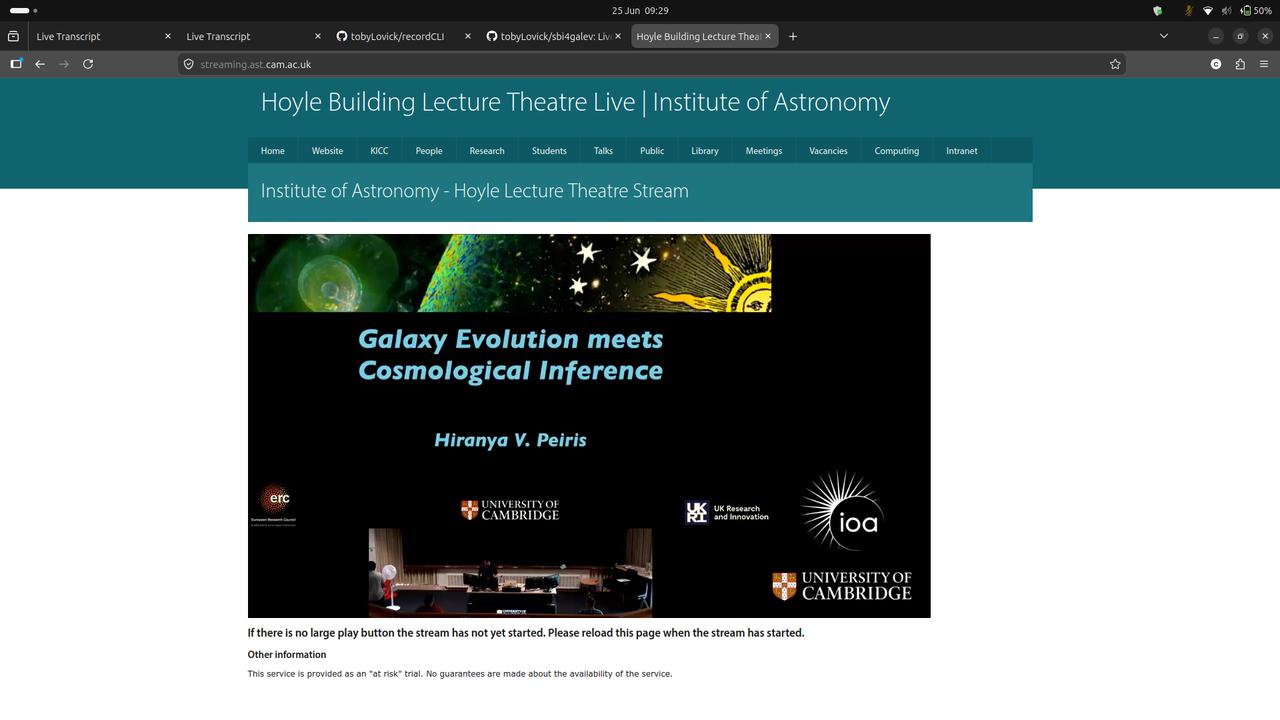
Galaxy Evolution Meets Cosmological Inference
The speaker presents pop-cosmos, a simulation-based inference framework designed to model the joint distribution of galaxy properties to reduce systematic uncertainties in next-generation cosmological surveys. By learning the relationship between multiwavelength photometry and physical properties, the framework improves photometric redshift calibration, mitigates intrinsic alignment contamination, and enhances Type Ia supernova standardization.
- Cosmological surveys like LSST, Euclid, and Roman are increasingly limited by systematic uncertainties related to galaxy population modeling.
- The pop-cosmos framework uses a generative model to learn the high-dimensional distribution of galaxy properties (redshift, mass, star formation, etc.) from deep photometric data.
- The model provides more accurate redshift distributions for weak lensing tomography compared to standard calibration techniques.
- Physically-motivated sample selection using pop-cosmos allows for the mitigation of intrinsic alignment by targeting specific galaxy types, reducing data loss from 40% to 10%.
- The framework improves Type Ia supernova standardization by using host galaxy property inference to reduce mass bias from ~7% to <1%.
- The system is scaling to process billions of galaxies, utilizing significant GPU resources (e.g., 620,000 GPU-hours) for Bayesian inference.
Abstract (conference schedule)
Next-generation cosmological surveys — LSST, Euclid, Roman — will be limited not by statistical power but by systematic uncertainties rooted in our understanding of galaxy populations. Photometric redshift calibration, intrinsic alignments, and baryonic effects on the matter power spectrum are all manifestations of the same underlying problem: cosmological inference requires an accurate model of the galaxy population and its evolution. I will present pop-cosmos, a simulation-based inference framework that learns the joint distribution of galaxy properties — redshift, stellar mass, star formation history, dust, metallicity, and black hole activity — from deep multiwavelength photometric data. The resulting generative model simultaneously delivers calibrated redshift distributions for weak lensing tomography, enables physically-motivated sample selection that mitigates intrinsic alignment contamination and unlocks multi-tracer clustering analyses, and provides improved Type Ia supernova standardisation through host galaxy property inference. It also reveals the astrophysical processes — including black-hole-driven feedback and the cessation of star formation — that shape the very populations we use as cosmological tracers. I will show applications spanning the Kilo-Degree Survey, DESI, the Zwicky Transient Facility, and COSMOS-Web, illustrating how a unified model of galaxy evolution connects to the next generation of cosmological constraints.
Questions for the speaker (3)
- How does the pop-cosmos framework handle the trade-off between model complexity and the risk of overfitting when learning the joint distribution of galaxy properties from the COSMOS-Web training set?
- Regarding the reduction of intrinsic alignment contamination, what specific physical properties are being used to define the 'clean' sample, and how was the 10% cut threshold determined to be sufficient?
- You mentioned that the model's abundances are not yet accurate when extrapolating to the brighter magnitude regimes of the Gamma survey; what specific modifications to the generative prior are needed to correct these abundance discrepancies?