Day 1 Tuesday 23 June 2026

The first day of SBI4GALEV focused on the integration of Simulation-Based Inference (SBI) and differentiable programming to accelerate galaxy evolution research. Presentations spanned the development of high-performance JAX-based frameworks and the use of neural emulators to bypass the computational costs of radiative transfer and stellar population synthesis. A strong emphasis was placed on moving beyond traditional SED fitting toward more complex, spatially resolved, and physically nuanced models of galaxy structure and kinematics.

Amortized and Likelihood-Free InferenceDifferentiable Forward Modeling with JAXNeural Emulation of Physical SimulatorsGenerative Models and Diffusion PriorsComputational Efficiency in Training Data Generation
No slides captured

Introduction to Likelihood-Free Inference

2026-06-23T10:19:21
Tom

This talk provides an overview of Likelihood-Free Inference (LFI), also known as Simulation-Based Inference (SBI), focusing on methods to perform Bayesian inference when analytical likelihoods are intractable. The speaker discusses various neural estimation techniques, model validation strategies, and a case study applying these methods to galaxy spectral energy distribution (SED) fitting.

  • Generalized Bayesian inference allows for updating beliefs using loss functions instead of analytical likelihoods, which is useful for misspecified models.
  • Likelihood-Free Inference (LFI) enables posterior estimation by sampling from a simulator rather than requiring an explicit likelihood function.
  • Neural Posterior Estimation (NPE) provides amortized inference, allowing fast sampling for new observations once the network is trained.
  • Alternative LFI methods include Neural Likelihood Estimation (NLE), Neural Ratio Estimation (NRE), and Neural Posterior Score Estimation (NPSE).
  • The 'SimFormer' architecture uses transformers and attention masking to handle missing data and joint distributions of data and model parameters.
  • Model validation in LFI requires techniques like simulation-based calibration and coverage testing to detect over- or under-confidence and bias.
  • A case study on galaxy photometry demonstrates that LFI can recover stellar mass and star formation rates with speed significantly exceeding traditional nested sampling.
Likelihood-Free InferenceSimulation-Based InferenceBayesian InferenceNeural Posterior EstimationAstrophysics
Questions for the speaker (3)
  1. How does the choice of loss function in generalized Bayesian inference specifically mitigate the effects of model misspecification compared to standard Bayesian methods?
  2. In the context of Neural Posterior Estimation, what are the practical trade-offs between using normalizing flows versus mixture density networks for representing the posterior?
  3. For the galaxy SED case study, how did the number of required simulations scale as the dimensionality of the parameter space increased?
No slides captured

Astronomic: A Plugin-Based Platform for Astronomical Data Analysis and Active Learning

2026-06-23T10:37:02
Grant Stevens

The speaker presents the evolution of Astronomic, a tool designed to handle imperfect labels and facilitate active learning in astronomy. The platform has been revamped from a monolithic structure into a modular, plugin-based architecture to improve scalability, reduce interdependencies, and allow for domain-agnostic scientific workflows.

  • Addressed the issue of imperfect labels in astronomy caused by incomplete data or telescope-specific biases.
  • Transitioned Astronomic from a domain-specific tool to a core platform where functionality is added via independent plugins.
  • Introduced a centralized context system featuring shared events, artifacts, and a job manager to decouple plugin communication.
  • Implemented a publish-subscribe event system (e.g., 'selection.change') to trigger automatic data retrieval and updates across the workspace.
  • Integrated various tools including Topcat for data manipulation, Hugging Face for image datasets, and Aladin for survey access.
  • Developed a dynamic workspace allowing users to customize layouts and manage large datasets, such as the Euclid Deep Field South.
Active LearningSoftware ArchitectureAstronomyPlugin SystemsData Visualization
Abstract (conference schedule)

Modern galaxy surveys and simulation-based inference pipelines increasingly require tools that can connect large datasets, machine learning models, domain expertise, and heterogeneous contextual information in an interactive and reproducible way. AstronomicAL was originally developed to address this need through active learning: allowing users to visualise catalogues, inspect informative or uncertain sources, update labels, and iteratively improve classification models with expert input. In this talk I will present the next stage of AstronomicAL: a plugin-based platform for building scientific pipelines around data, models, simulations, and expert decisions. The motivation is that many research workflows do not fail because a model cannot be trained, but because the work around the model is fragmented. In practice, these surrounding steps are often scattered across scripts, archive queries, manual inspection, and informal records. AstronomicAL aims to bring these pieces into a shared workspace, where model outputs, contextual evidence, annotations, and follow-up decisions become connected parts of the same reproducible workflow. This changes AstronomicAL from an active learning dashboard into an interactive workbench for scientific analysis. In astronomy, this could mean moving from an unexpected model prediction or unusual SBI posterior to a connected evidence-gathering process that helps researchers decide whether to trust a model, retrain it, refine the simulation design, or pursue observational follow-up. More generally, the same architecture can support workflows in which researchers compare competing models through their failure modes, steer expensive simulations, reconcile conflicting data sources, or construct benchmark samples. By making these steps composable through plugins, AstronomicAL aims to turn fragmented research code into reusable, auditable workflows guided by domain expertise.

Questions for the speaker (3)
  1. How does the artifact store handle memory management and data persistence when dealing with very large datasets, such as the 13 million rows from the Euclid Deep Field South?
  2. Regarding the proposed 'plugin marketplace,' what mechanisms will be used to ensure version compatibility and stability when users install community-made plugins?
  3. You mentioned that the system is now domain-agnostic; what are the specific minimum requirements or data structures a non-astronomy dataset must follow to be compatible with the core platform's event system?
11 slides

Pop-Cosmos: A Generative Model for the Galaxy Population

2026-06-23T11:15:30
Stephen Thorp

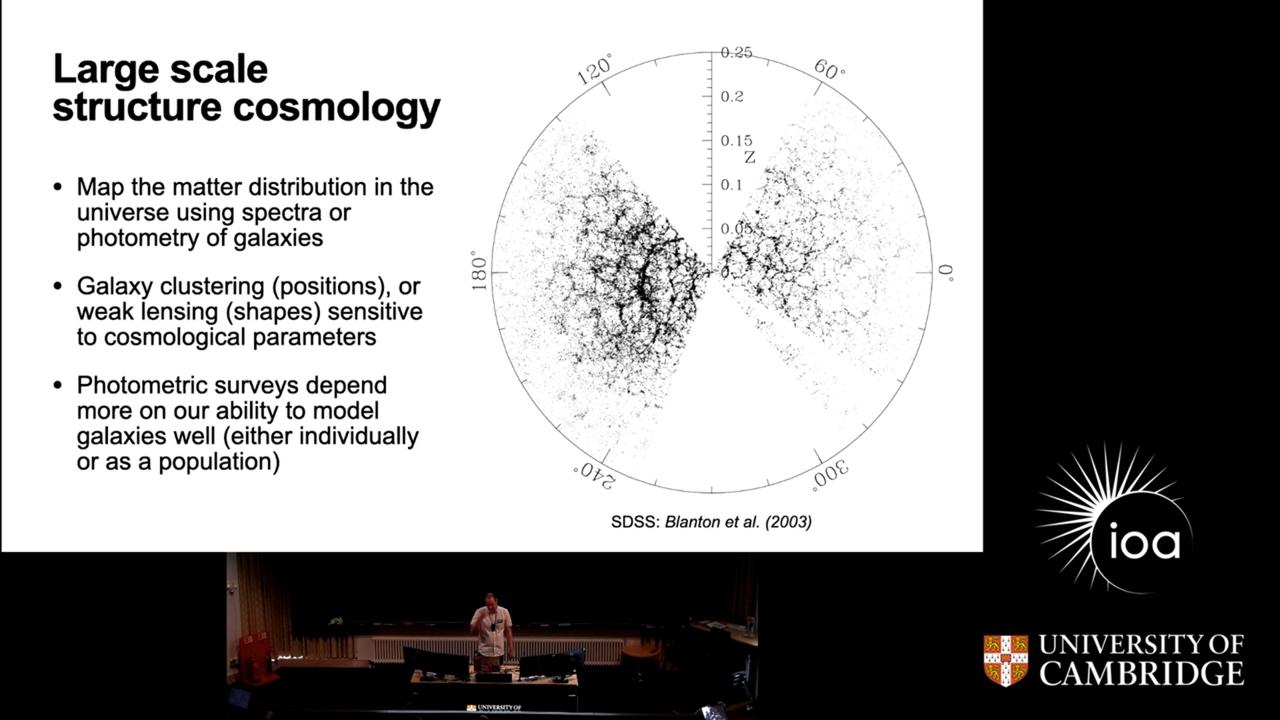
The speaker presents Pop-Cosmos, a generative model designed to forward-simulate galaxy populations to improve cosmological measurements and galaxy evolution studies. The framework uses a diffusion model to represent the distribution of physical parameters, which are then mapped to observables via a neural network emulator of stellar population synthesis (SPS) codes.

  • Motivated by the need for accurate redshift distributions (n(z)) in tomographic photometric surveys for large-scale structure cosmology.
  • The model pipeline consists of a population distribution (represented by a diffusion model), an SPS emulator for mapping physical parameters to fluxes, and a module for observational noise and selection effects.
  • Training is performed using simulation-based calibration, minimizing a distance metric between forward-simulated observations and real data from the COSMOS2020 catalog.
  • The learned population distribution can be used to predict results for new surveys, extract galaxy evolution trends, or serve as a data-driven prior for individual galaxy parameter inference.
  • Validation results show the model can effectively recover redshift distributions and provide accurate photometric redshift estimates.
Generative ModelsCosmologyGalaxy Population SynthesisDiffusion ModelsPhotometric Redshifts
Abstract (conference schedule)

Projects such as the Vera C. Rubin Observatory and Euclid offer a huge opportunity to study galaxies and their evolution across wide areas of the sky. However, this is only possible if we are able to efficiently and accurately model our observations of the galaxies, and thus infer their redshifts and physical properties from limited photometric data (typically 4-10 bands). The pop-cosmos framework is a stellar population synthesis (SPS)-based generative model for the galaxy population, built around a machine-learned prior (a score-based diffusion model) over 16 galaxy-level parameters, and trained on 26-band photometry taken from the Cosmic Evolution Survey (COSMOS). In this tutorial, we will demonstrate several aspects of the public pop-cosmos codebase (https://github.com/Cosmo-Pop/pop-cosmos): (i) using the population model as a forward simulator of galaxy photometry and spectral energy distributions (SEDs); (ii) performing galaxy-level Bayesian inference with the trained diffusion model as a prior; and (iii) amortizing galaxy-level inference with flow-based models built using our public library (https://github.com/Cosmo-Pop/flowfusion).

Questions for the speaker (3)
  1. How was the distance metric for the simulation-based calibration chosen, and why was it preferred over other divergence measures for matching the simulated and observed data distributions?
  2. Since the IMF and stellar templates are fixed beforehand, how does the model account for potential systematic biases introduced by these fixed assumptions?
  3. What are the computational trade-offs and accuracy losses when using a neural network emulator for stellar population synthesis compared to running the full SPS codes?
18 slides

SE3D: A Novel Modeling Technique for Chromatic Resolved Galaxy Observations

2026-06-23T11:30:31
Stephen Ramnichal

The speaker introduces SE3D, a modeling tool designed to jointly and self-consistently interpret galaxy structure, stellar populations, and dust geometry using 3D radiative transfer. To overcome the computational cost of radiative transfer, the team developed a machine learning emulator that maps physical parameters to observables, allowing for the extraction of physical properties from panchromatic data.

  • SE3D moves beyond conventional SED fitting by relaxing assumptions of spatially uniform stellar populations and foreground dust screens.
  • The tool utilizes a 16-parameter model of galaxies processed through the SKIRT radiative transfer library.
  • A machine learning emulator was trained to rapidly predict observables (SED, half-light radius, Sersic index, axis ratio) from physical parameters.
  • SE3D can decouple attenuation and reddening, providing a more nuanced understanding of star-dust geometry than standard Calzetti-like laws.
  • Testing on mock-observed TNG50 galaxies revealed model mismatches stemming from bursty star formation histories, metallicity distributions, and erratic dust structures.
Galaxy ModelingRadiative TransferMachine Learning EmulatorsSED FittingDust Geometry
Abstract (conference schedule)

Galaxy growth has traditionally been explored through two complementary perspectives: the build-up of stellar mass inferred from galaxy integrated SED modelling, and the growth in size captured by high-resolution imaging. Together, these methods have driven substantial progress in our understanding of galaxy evolution. However, SED fitting typically relies on simplified assumptions, such as a foreground dust screen and a non-varying stellar population, limiting the physical realism of inferred properties. In parallel, increasingly rich datasets on high-redshift galaxies (from UV to mm) gathered from deep multi-wavelength observations suffer from differing spatial resolutions, resulting in a mixture of highly resolved, marginally resolved and unresolved data. To address both limitations, we developed a novel modelling technique aimed at maximally exploiting all of this rich yet varied information without sacrificing unresolved or poorly resolved bands, and without sacrificing resolution where available. Our modelling approach is fundamentally 3D in nature, and extracts information on stellar populations and their radial variations as well as star-dust geometries, without imposing an attenuation law a priori. We jointly model observational constraints on wavelength dependent fluxes, sizes, Sérsic profile shapes, and axial ratios using a computationally efficient machine learning emulator trained on an extensive toy model library of dust radiative transfer calculations. Applications to TNG50 galaxies and the COSMOS/GOODS-South fields will be discussed in detail.

Questions for the speaker (3)
  1. How does the choice of a log-normal function for star formation history specifically limit the recovery of properties in bursty TNG50 galaxies compared to the toy models?
  2. Given that the emulator currently only goes up to 6 millimeters, what specific radiative transfer effects are being omitted that would be captured by extending the wavelength range?
  3. To what extent does the assumption of a galaxy-wide metallicity introduce systematic biases when fitting real galaxies that likely possess strong metallicity gradients?
22 slides

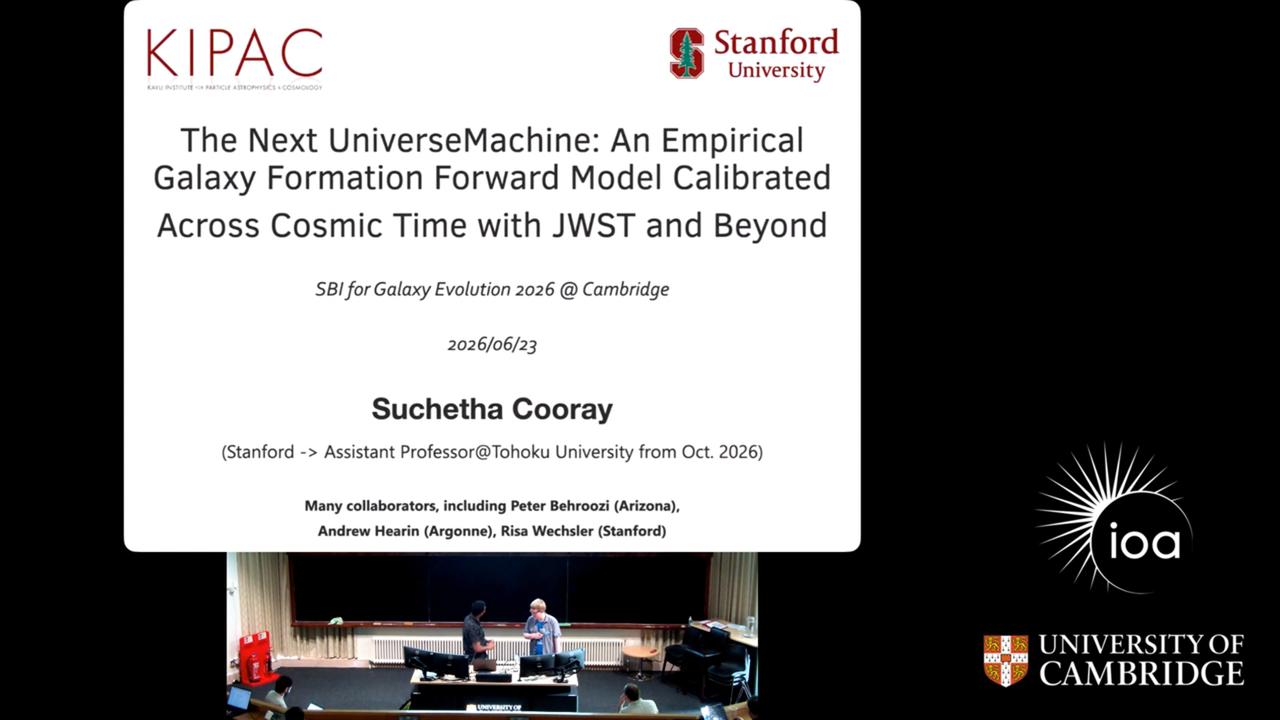
UNiverse Machine 2 and Tengri: Differentiable Frameworks for Galaxy Formation and Inference

2026-06-23T11:46:01
Suchetha Cooray

The speaker presents UNiverse Machine 2, an updated model for galaxy formation that incorporates bursty star formation histories, and introduces Tengri, a new differentiable forward modeling framework written in JAX. Tengri leverages the NIFTY framework to enable high-dimensional joint posterior inference across millions of parameters, aiming to unify various physics models into a single modular pipeline.

  • UNiverse Machine 2 improves upon previous versions by incorporating bursty star formation sampled from a power spectral density (PSD) to better match observed luminosity ratios and main sequence scatter.
  • Tengri is designed as a modular, differentiable framework in JAX to separate physics modeling from the inference backend.
  • The framework utilizes NIFTY to handle extremely high-dimensional inference, such as joint posterior estimation for millions of parameters across thousands of galaxies.
  • Tengri aims to reduce systematic differences between various SED fitting codes (e.g., Cigale, Prospector) by providing a unified base for reproducing their results.
  • The speaker demonstrates the efficiency of JAX compilation, showing that forward kernels can run in tens of microseconds on a CPU after the initial compile.
  • Tengri supports complex applications including Bayesian model averaging and hierarchical inference of star formation histories.
Galaxy FormationDifferentiable ProgrammingBayesian InferenceJAXSED Modeling
Abstract (conference schedule)

Empirical galaxy formation models offer a powerful complement to more physics-first simulations: they are flexible, observation-driven, and computationally tractable enough to enable rigorous statistical inference. We present UniverseMachine (UM) DR2 , a major update to the pre-JWST UniverseMachine framework (Behroozi et al. 2019). UM DR2 now matches a comprehensive compilation of observational constraints spanning z ∼ 0–20, including the latest JWST observations at z > 10 that challenged earlier models. Now the model simultaneously reproduces key observable statistics, like stellar mass functions, UV luminosity functions, bursty star formation rate distributions, cosmic star formation rate density, and quiescent fractions across the full observed redshift range. The model encodes the galaxy-halo connection through a minimal, physically motivated parametrization of star formation rates as a function of halo mass, mass accretion rate, and redshift, preserving cosmological consistency while remaining sufficiently flexible to capture the uncertain physics. We leveraged simulation-based inference to perform posterior estimation over the full model parameter space, enabling rigorous uncertainty quantification and principled model comparison that would be intractable with traditional sampling approaches. I will present the current calibrated model and discuss about the physical drivers of galaxy growth and quenching across cosmic time. We provide public catalogs that will enable forward-modeling and SBI applications with JWST, Roman, Rubin LSST, and PFS.

Questions for the speaker (3)
  1. How does the choice of the Gaussian approximation for the posterior in the NIFTY framework impact the accuracy of the inference when dealing with the 'banana-shaped' posteriors you mentioned?
  2. Regarding the reproduction notebooks, what were the primary sources of the discrepancies you found when matching Tengri's results with codes like Cigale or Prospector?
  3. For the hierarchical model sampling 1.13 million dimensions, how does the computational scaling of the variational inference approach compare to traditional MCMC methods as the number of galaxies (N) increases?
22 slides

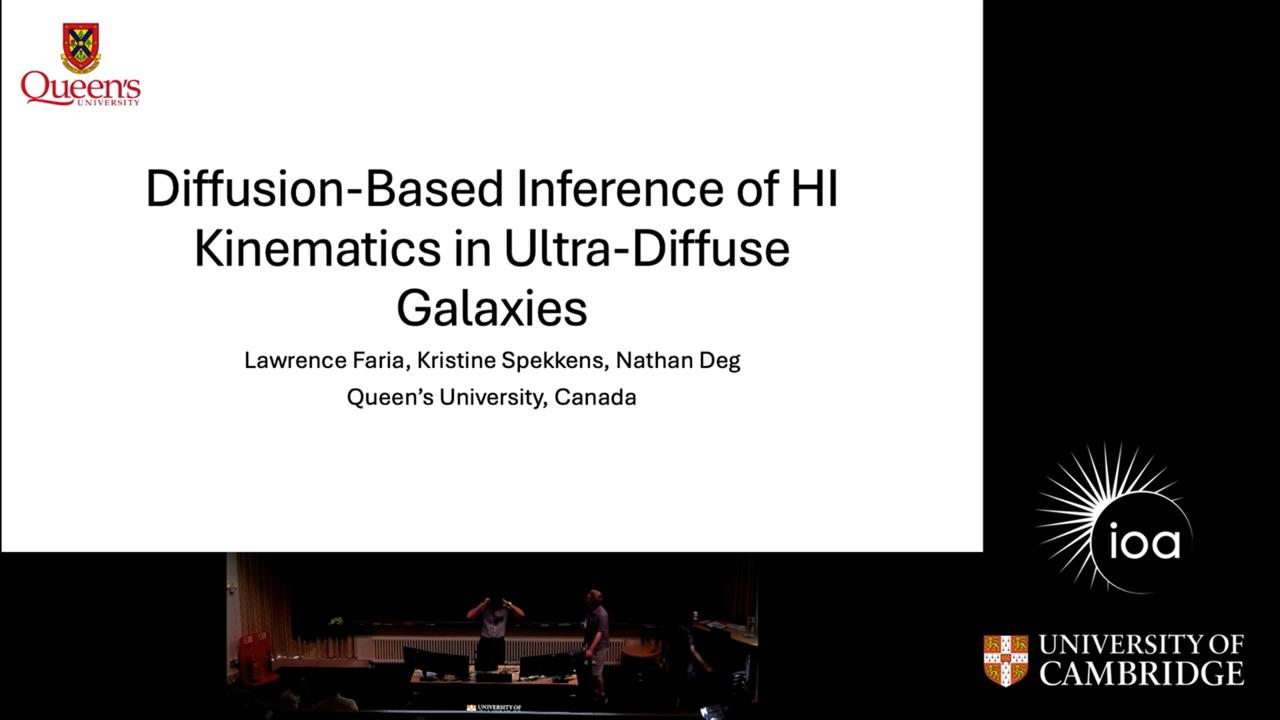
Diffusion-Based Inference of HI Kinematics in Ultra-Diffuse Galaxies

2026-06-23T13:30:27
Lawrence Faria

The speaker presents a new Bayesian inference framework using diffusion models to recover rotation curves for ultra-diffuse galaxies (UDGs) from HI data cubes. This approach aims to overcome the failures of traditional tilted ring models in low-resolution, low-inclination regimes by providing more reliable posterior uncertainties and better recovery of intrinsic kinematics.

  • Ultra-diffuse galaxies (UDGs) challenge current galaxy evolution models due to their low surface brightness and large radii.
  • Traditional tilted ring models often fail gracefully in low-resolution regimes (below 3 resolution elements across the major axis), producing plausible-looking but incorrect rotation curves.
  • The proposed method uses a diffusion model to learn a prior over intrinsic disk structures, which are then forward-modeled through a telescope-specific response.
  • Sequential Monte Carlo (SMC) is used to sample the posterior, allowing for the recovery of rotation curves and geometric parameters like inclination and position angle.
  • Testing on simulated data shows that the model correctly reflects uncertainty, with broader posteriors at lower resolutions and face-on inclinations.
  • Future work includes incorporating cosmological and hydrodynamical simulations into the training set and moving from image-space to higher-level data products.
Ultra-Diffuse GalaxiesHI KinematicsDiffusion ModelsBayesian InferenceRotation Curves
Abstract (conference schedule)

Ultra-Diffuse Galaxies (UDGs) are an extreme population of low surface brightness galaxies that challenge our understanding of galaxy formation and evolution. Despite their faint stellar component, many are rich in neutral hydrogen (HI), making them ideal targets for kinematic studies. However, the limited spatial resolution, low rotation speeds, and uncertain inclinations typical of UDGs place these systems in a regime where traditional tilted-ring kinematic models are poorly constrained, complicating efforts to determine their dark matter content and evolutionary pathways. Using new VLA HI observations together with forward-modelled synthetic data cubes, we are developing diffusion models as a simulation-based inference approach to recover galaxy kinematics directly from HI data. Trained on simulated observations, these models provide a framework for inferring kinematic parameters and their uncertainties in regimes where traditional methods are uncertain. In this talk, I will present the VLA HI observations, preliminary kinematic modelling, and the development of diffusion-based inference for HI-rich UDGs.

Questions for the speaker (3)
  1. How does the choice of the specific diffusion model architecture impact the ability to capture non-axisymmetric features like warps or overdensities compared to the current simulation-based prior?
  2. Given that the telescope response varies by the hour, how is the beam convolution handled computationally during the likelihood step of the Sequential Monte Carlo sampling to maintain efficiency?
  3. What specific metrics were used to determine that traditional tilted ring models fail 50% of the time below three resolution elements, and how does the diffusion-based approach quantify its own failure rate in those same regimes?
44 slides

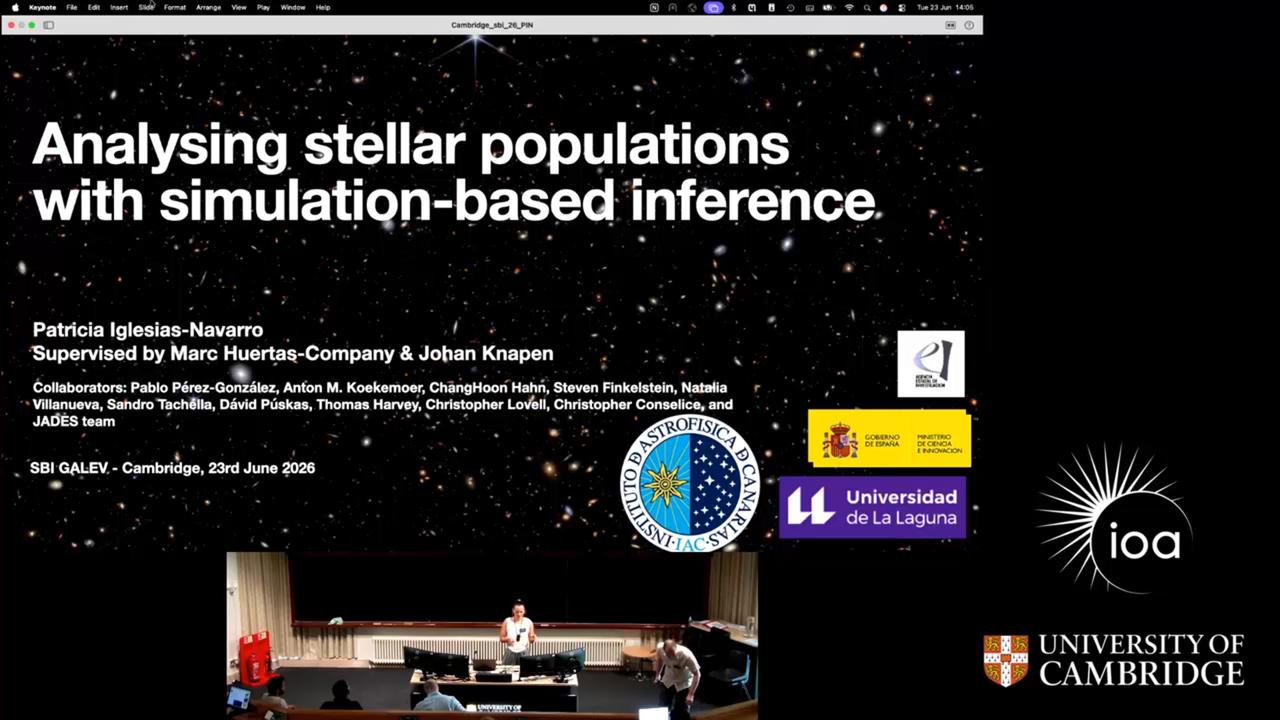
Decoding the SED: Disentangling galaxy physics from the rest-frame optical

2026-06-23T14:35:19
Patricia Iglesias-Navarro

The speaker presents a framework for analyzing galaxy properties using simulation-based inference (SBI) and normalizing flows to overcome the computational costs of traditional MCMC methods. The work progresses from integrated spectral analysis to pixel-by-pixel SED fitting, enabling the study of galactic clumps and the identification of primordial Population III star candidates.

  • Utilized simulation-based inference and normalizing flows to provide fast, amortized posterior distributions for stellar population properties.
  • Implemented a dimensionality reduction architecture with an attention mechanism to compress 4,300-component spectra into 16 latent representations.
  • Demonstrated that the SBI approach is significantly faster (by several orders of magnitude) than traditional codes like pPXF while providing essential uncertainty estimates.
  • Extended the method to pixel-by-pixel SED fitting, allowing for the mapping of star formation rates and metallicities across individual galaxies.
  • Applied the pixel-level analysis to identify potential Population III star clumps in high-redshift galaxies by comparing Pop III models against fiduciary Pop I/II models.
Simulation-Based InferenceSpectral Energy Distribution (SED)Normalizing FlowsPopulation III StarsGalaxy Evolution
Abstract (conference schedule)

Simulation-based inference (SBI) enables fast, well-calibrated posterior estimation for high-dimensional inverse problems in astronomy. We present SBIPIX, an amortized neural density estimation framework that performs full Bayesian inference on galaxy spectral energy distributions at the pixel level ($\sim 10^{-4}$ s per pixel)---orders of magnitude faster than traditional MCMC methods while maintaining accurate uncertainty quantification. SBIPIX leverages FSPS (Flexible Stellar Population Synthesis) forward models to generate synthetic training datasets with both parametric and non-parametric star formation histories \citep{Leja2019, Iyer2017}. Validation against MILES-based synthetic galaxies \citep{Vazdekis2010} demonstrates robust recovery of stellar mass, age, dust attenuation, and SFR across $z \approx 0.5$--$10$. The amortized network generalizes efficiently to new observations, enabling application to millions of pixels in JWST imaging. We apply SBIPIX to JADES (JWST Advanced Deep Extragalactic Survey; \citealt{Eisenstein2023}) multiband NIRCam and HST/ACS data, generating spatially-resolved physical property maps for thousands of galaxies. This enables two science applications: (1) identifying star-forming substructures and clumps in galactic disks with unprecedented precision using resolved stellar mass and SFR, and (2) using Synthesizer \citep{Lovell2025, Roper2025} with pristine stellar population synthesis models (Yggdrasil; \citealt{Zackrisson2011}) to quantify Population III detectability limits using SBI-derived posteriors, demonstrating how amortized SBI accelerates Bayesian analysis in extragalactic surveys and enables scientific discoveries at sub-galactic scales.

Questions for the speaker (3)
  1. How did you determine that 16 components were the optimal size for the latent representation, and did you test the sensitivity of the results to different compression ratios?
  2. Given that pixels are below the PSF size and thus spatially correlated, how would incorporating a spatial prior or a Gaussian Process into the inference change the resulting property maps?
  3. Regarding the Population III candidate identification, how do you distinguish between a true primordial signal and a metal-poor Population II population given the limitations of broadband photometry?
12 slides

Differentiable SED Simulation with Ceridwen

2026-06-23T15:16:34
Amanda Stoffers

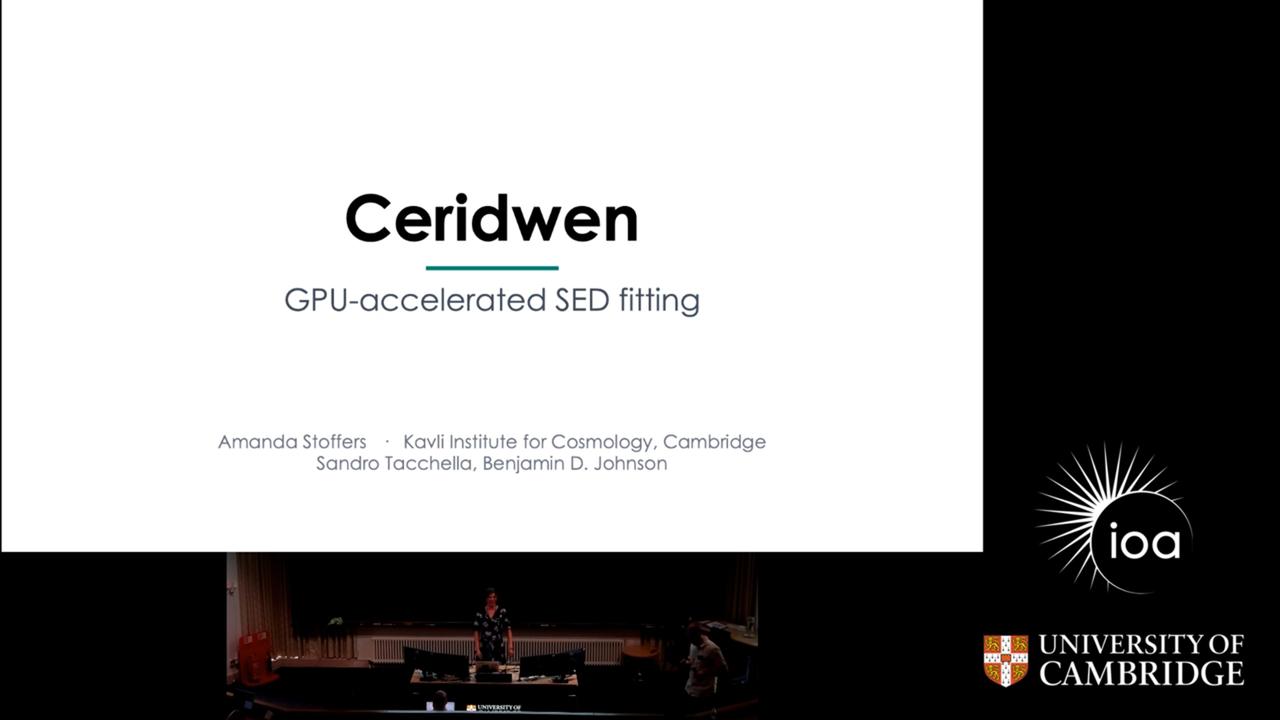
The speaker introduces Ceridwen, a next-generation spectral energy distribution (SED) fitting code written in JAX to provide a differentiable, GPU-optimized alternative to existing tools. The code emphasizes flexibility in forward modeling to better address tensions in early JWST data, such as unexpectedly massive early galaxies, by allowing for more complex star formation and chemical evolution histories.

  • Ceridwen is built using vectorized JAX, making it differentiable, jittable, and optimized for GPUs.
  • The code fully replicates Prospector and FSPS while offering significantly faster performance, reported as up to 34 times faster in some tests.
  • It features a modular forward model allowing users to customize star formation histories (SFH), chemical evolution, and dust attenuation/emission.
  • The tool supports non-parametric SFH and simultaneous fitting of chemical evolution and nebular modeling.
  • It integrates with the BlackJAX package to support various samplers, including HMC, NUTS, and nested sampling.
  • Preliminary tests demonstrate the ability to recover bursty SFHs and time-varying metallicity histories from single spectra.
SED fittingJAXGalaxy EvolutionJWSTDifferentiable Programming
Abstract (conference schedule)

The depth, resolution, and sheer volume of high-redshift spectra from JWST and many more large scale surveys have outpaced the models we use to interpret them. Simulations and observations agree that real star-formation histories (SFHs) are more complex than parametric models can describe, with phases of star bursts, mini-quenching and rejuvenation. Flexible, non-parametric models address this, but at the cost of a steep rise in parameter dimensionality that strains conventional inference. I present CERIDWEN, a JAX-based, GPU-accelerated SED-fitting framework built around a fully differentiable forward model. Because the simulator is differentiable and vectorized, it sustains a roughly constant evaluation throughput as model complexity grows, making it tractable to fit hundreds of SFH bins, time-varying chemical-enrichment histories, and modular per-age-bin dust, recovering these jointly from a single spectrum. On real JADES galaxies it reproduces the state-of-the-art SED fitting code Prospector at a large reduction in wall-clock cost. Beyond its current gradient-based samplers, this fast differentiable simulator is natural infrastructure for simulation-based inference: a source of cheap simulation budgets, and a problem where exact posteriors can validate amortized methods. I will close with an open question for discussion: how best to bring a physically realistic but expensive, non-differentiable nebular model into an SBI framework.

Questions for the speaker (3)
  1. How does the current implementation of the nebular emission block handle the transition to the planned overhaul of the Byler 2017 CLOUDY grids?
  2. Regarding the recovery of bursty SFHs, what specific data quality or spectral resolution is required to resolve two closely spaced starburst events that the current model struggles to separate?
  3. You mentioned the challenge of creating a physically informed prior for the fundamental metallicity relation; what specific mathematical constraints are you testing to allow for deviations while maintaining physical plausibility?
11 slides

Cheap, physics-informed training data for SBI

2026-06-23T15:31:37
Richard Stiskalek

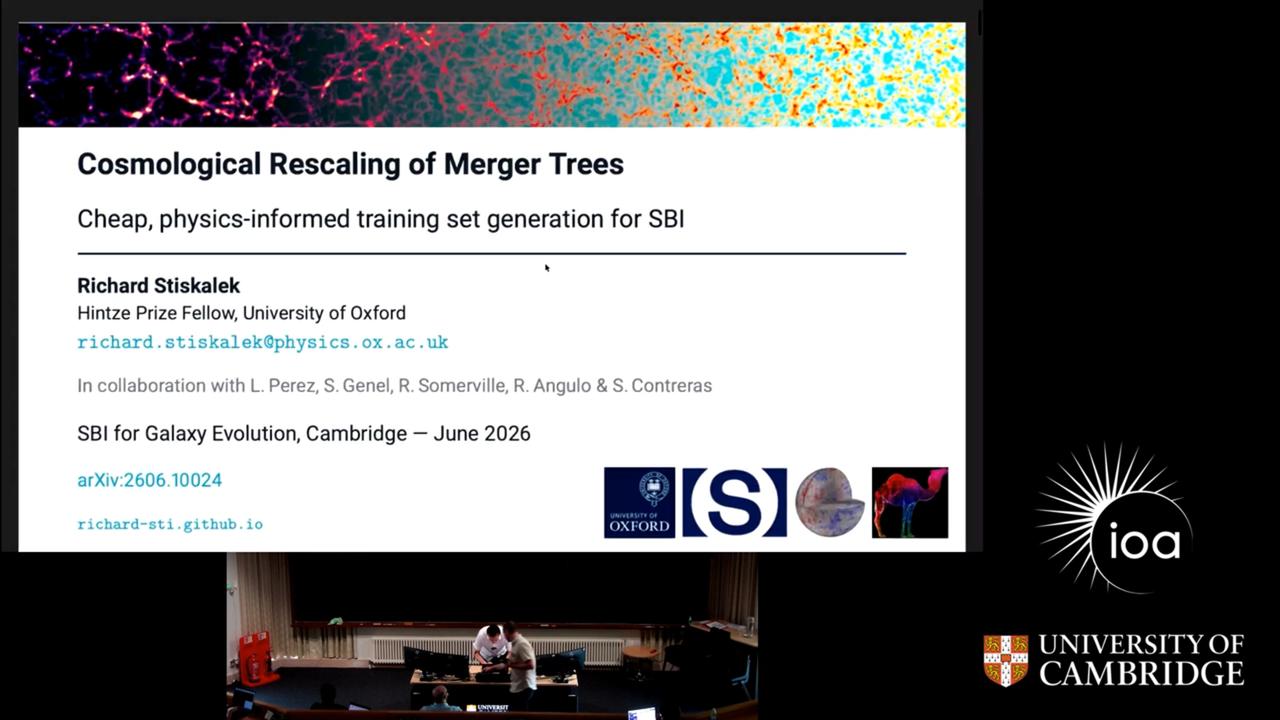
The talk presents a method to alleviate the computational bottleneck of generating training sets for Simulation-Based Inference (SBI) in galaxy clustering. By extending cosmological rescaling algorithms to dark-matter merger trees, the speaker demonstrates how a small number of expensive N-body simulations can be used to cheaply generate large, unbiased training sets for semi-analytic models (SAMs).

  • Training data generation is a primary bottleneck for SBI in cosmology, often requiring thousands of expensive N-body simulations to converge.
  • Cosmological rescaling allows an existing N-body simulation to be mapped to a nearby cosmology by matching linear matter variance and scaling lengths, positions, and masses.
  • The speaker extends this rescaling technique specifically to merger trees, assuming the topological links between halos remain unchanged while timing and properties are adjusted.
  • Validation using the Santa Cruz SAM shows that rescaled merger trees produce stellar mass functions and two-point correlation functions with less than 5% scatter and no significant systematic bias.
  • Using as few as ~64 base simulations rescaled to a larger set can match the performance of a model trained on 750 full N-body simulations.
  • Augmenting existing training sets with rescaled simulations can improve parameter estimation (e.g., Omega_m) by approximately 25% by providing a physically motivated interpolation.
Simulation-Based InferenceN-body simulationsCosmological rescalingMerger treesSemi-analytic modelsGalaxy clustering
Abstract (conference schedule)

Learning cosmology from galaxy surveys demands large simulation suites spanning cosmological and astrophysical parameters, yet hydrodynamical galaxy-formation simulations are prohibitively expensive. Semi-analytic models are cheaper and physically grounded, but still require N-body merger trees, and densely sampling parameter space remains costly. We extend cosmological rescaling to operate directly on merger trees in the Ωₘ–σ₈ plane, running the Santa Cruz semi-analytic model on the rescaled trees to generate galaxy populations at new parameters for negligible cost. We further demonstrate that gradients can be propagated through the existing merger trees, opening a route to gradient-based inference. A halo-profile-based correction, set by a single free parameter, suppresses rescaled-mass bias below the per-cent level. For inference of Ωₘ and σ₈ from the stellar mass function or two-point correlation function, as few as 64 base simulations rescaled to ~1000 samples match 750 dedicated N-body runs; rescaling to 3200 improves Ωₘ by ~25%. Rescaling one CAMELS-SAM simulation costs ~0.1 CPUh versus several thousand.

Questions for the speaker (3)
  1. Since the rescaling method assumes that the topological links between halos in merger trees remain unchanged, at what point does the difference in cosmology become large enough that this assumption fails and introduces significant bias?
  2. You mentioned that higher-order statistics like the three-point correlation function might be less accurate; do you have a quantitative estimate of the error threshold where rescaled trees cease to be a viable substitute for full N-body runs?
  3. Regarding the proposed move toward differentiable merger trees in JAX, how do you plan to handle the non-differentiable nature of the discrete merging events within the tree structure?
44 slides

Degeneracy Distillery: Learning Information Geometry for Simulation-Based Inference

2026-06-23T17:34:30
Lucas Makinen

The talk introduces 'Degeneracy Distillery,' a three-step pipeline designed to identify and resolve parameter degeneracies in simulation-based inference (SBI). By mapping complex information geometry to a flat latent space and distilling symbolic expressions, the method improves inference scalability and reveals underlying physical relationships in cosmological, astrophysical, and epidemiological models.

  • Parameter degeneracy occurs when multiple combinations of control parameters produce identical data, often appearing as 'banana-shaped' posteriors.
  • The proposed pipeline first learns the Fisher information geometry using a neural network to create an oracle of the inverse covariance.
  • A second 'flattener' network maps the original parameter space to latent coordinates where the metric is approximately the identity matrix.
  • The final step uses symbolic regression to distill these latent coordinates into human-readable mathematical expressions of the original parameters.
  • Applying this method to gravitational wave data recovered an approximation of the chirp mass, while an epidemiology example recovered the basic reproduction number (R0) as a ratio of infection and recovery rates.
  • Using flattened coordinates reduces the simulation budget required for well-calibrated inference and mitigates the curse of dimensionality in normalizing flows.
Simulation-Based InferenceInformation GeometryFisher InformationSymbolic RegressionParameter Degeneracy
Questions for the speaker (3)
  1. How does the symbolic regression step handle the trade-off between the complexity of the mathematical expression and the accuracy of the flattening, specifically regarding the minimum description length mentioned?
  2. In the gravitational wave example, you noted that the learned coordinates outperformed traditional chirp mass and symmetric mass ratio; what specific physical features of the more detailed waveform model caused the traditional coordinates to become less informative?
  3. Since the 'flattener' network is trained to minimize the difference between the Jacobian and the identity matrix, how does the method perform when the underlying information geometry is fundamentally non-flat or possesses topological singularities?