 22 slides
Addressing the Simulation Bottleneck in Simulation-Based Inference
This pedagogical talk explores strategies to overcome the high computational cost of generating simulations for Simulation-Based Inference (SBI) in cosmology and astrophysics. The speaker discusses methods to reduce the number of required simulations, lower the cost per simulation, and maximize the information extracted from each run, illustrating these concepts through a case study on galaxy-scale strong lensing.
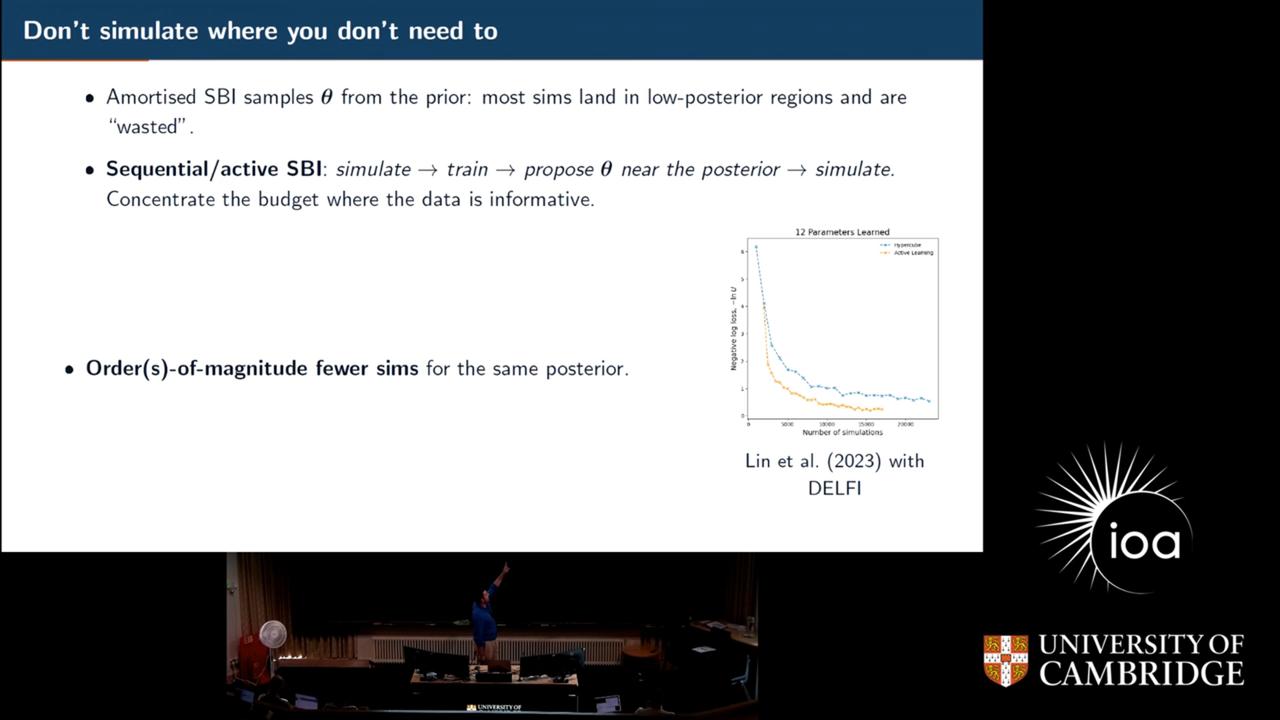
- Sequential and active learning can reduce the number of simulations needed by focusing on high-posterior regions of the parameter space.
- Multi-fidelity SBI and transfer learning allow the use of cheap, low-fidelity models (e.g., analytic or log-normal) to inform high-fidelity N-body or hydro simulations.
- Emulators can bypass expensive computations, though they introduce risks of out-of-distribution errors and up-front training costs.
- JIT-compilation and GPU migration (e.g., using JAX) significantly speed up forward models and facilitate differentiable compression.
- Neural compression and hybrid statistics (combining neural embeddings with power spectra) improve the information gain per simulation.
- Application to strong lensing demonstrates that SBI can handle 'dirty' images (e.g., from ALMA) without traditional cleaning by focusing on substructure response.
Abstract (conference schedule)
The application of Simulation-Based Inference (SBI) in galaxy evolution and cosmology provides a powerful implicit-likelihood framework to connect fundamental physics with complex observational data from telescopes such as Euclid, the Rubin Observatory, DESI, and JWST. However, the field faces a critical computational bottleneck: the massive simulation budget required to forward-model multi-scale phenomena, from the detailed sub-grid baryonic physics of galaxy formation to large-scale dark matter structure. This discussion session will synthesise recent advancements designed to dismantle these limitations. Drawing on successes from recent massive survey pipelines and proof-of-concept studies (e.g., emulation of the galaxy-halo connection or rapid spectro-photometric SED fitting), we will explore how novel sequential and active learning approaches iteratively target high-dimensional parameter spaces, reducing simulation budgets by orders of magnitude. We will also discuss strategies for maximising the utility of existing simulation suites, such as utilising multi-fidelity transfer learning, or reducing the need for data compression by deploying highly expressive neural density estimators. Furthermore, we will examine the critical role of neural emulators in bypassing expensive hydrodynamical runs altogether, alongside the practical trade-offs of migrating legacy CPU-based astrophysical codes to highly parallelised GPU architectures and differentiable programming frameworks. Ultimately, this session aims to collate the diverse computational tools currently at the community’s disposal, establishing community best practices and identifying which combinations of these approaches will most effectively drive the next generation of cutting-edge SBI analyses.
Questions for the speaker (3)
- How do you rigorously quantify and propagate the errors introduced by using low-fidelity models or emulators within the SBI framework to ensure they do not bias the final posteriors?
- For non-differentiable physics such as radiative transfer or nebular models, what specific surrogate architectures or 'learning around' techniques do you propose to maintain a differentiable pipeline?
- In your strong lensing work, how does the performance of the physically-informed 'Lensformer' layer compare to a standard CNN when marginalizing over nuisance parameters and systematics?